special Projects
Research and writing about the Geary Act

Braids and Belonging: Hairstyles in the Certificates of Residence
by Kaylee Da
September 2026
The queue — biànzi (辫子) in Chinese — is a long braid historically associated with the Manchus, the people of Manchuria. It required a man to shave the front half of his head and braid the rest into a single tail down his back.
Western media and political cartoons in the nineteenth and early twentieth centuries frequently mocked Chinese men for the queue. Within China, the style once meant life or death. When the Qing Dynasty consolidated power across China, the emperor issued an ultimatum in 1645: every man had 10 days to adopt the queue, or he would face execution.
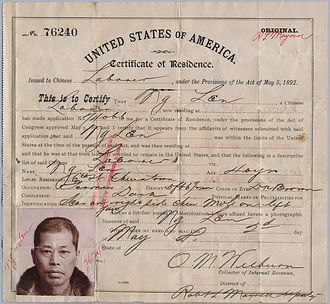
In the United States and Hawai’i, Chinese men had no legal requirements to maintain the hairstyle. Yet many portraits on the Certificate of Residence show men still wearing it, while others show short or Western-style hairstyles.
The article illuminates late-nineteenth-century Chinese-American history through the lens of an individual’s hairstyle. It suggests how a Chinese American man could have styled his hair was not purely a form of self-expression, but that his hairstyle could reveal circumstances and pressure that could have shaped a period of his life.
This article does not set out to prove a single conclusion about why each man kept their hair as it did. It draws on existing research and primary sources to offer reasoned interpretations of why one could choose to do so. As a byproduct, it shows the importance of preserving one’s certificate of residence, for they are not merely records of who these men were, but give traces to the environment they lived through.
My name is Kaylee, and I am a High School Junior at Newton South High School. I have an interest in material culture, and one of my favorite things to do while archiving is studying the portraits of the people on their certificates. Throughout my time, I have observed more than 250 certificates, and I wanted to write about a topic that I firmly believe is underexplored in the broader study of Chinese-American history.
The most immediate recognizable group of hairstyles among the certificates of residence are the men who have kept their queues. Given that the hairstyle was no longer required, the obvious question is why anyone would keep it.
Dated 1894, a card from Seattle records a “Chinese Laborer” named Charley Kee, also known as Ng Hock On. In his residence card, Kee is documented as a cook. Two years earlier, Kee had asked for permission to file an affidavit certifying his merchant status at Gim Lung Company in Port Townsend, Washington. In a system where mistranslation in paperwork could threaten one's immigration status, the portrait Charley Kee chose to present himself offers its own sort of stance. Though in his portrait, the braid itself is not visible, the front and sides of his scalp are shaved except for the back hair, which strongly supports the idea that he wore a traditional queue.
Until the 1911 Chinese revolution, a Chinese man who had returned to China without a queue would likely expect a lot of trouble during reentry. A missing braid invites suspicion about one’s loyalty to China. This risk incentivized many Chinese-Americans who planned to return to China—-permanently or temporarily—-to keep their queue. For a person like Kee, the queue could have acted as a shield against distrust when he traveled abroad.
For sojourners, who planned their time in the United States as temporary work rather than permanent settlement, the braid was equally necessary for entry. For this reason, a portrait of a person with a queue could register one’s intention of future settlement.
For many manual laborers, preservation of a queue, however, came at a dangerous cost. In addition to the inconvenience of a dangling braid during work, the queues could serve as an object of harassment. The queue was vulnerable to being grabbed, yanked or pulled. Many who kept their braids often coiled the braid tightly across the head as a form of accommodation to the demands from work.
The certificate of residence of Dang Fong of Oahu, a twenty-year-old overseer, is one of the few submitted to have exactly this hair arrangement. His small adjustment could reflect the work environment he had to endure and may hint that he viewed his days in the United States as only provisional.
Keeping the queue consistent was an additional burden. To stay compliant with Qing laws, the front half of the scalp had to be shaved smoothly every 10 days. The portrait of Jen Ron, a twenty-five-year-old sugar planter located in Waianae, Hawaii, shows a braid tucked in the back and a distinct regrowth across the front of the scalp, where the skin would have been required to be clean inside China. Though the reason for the regrowth is undeterminable, the portrait does record the drifting distance of the Qing Government's demand to what a laborer could maintain.
Not every man kept their queue. The absence of a braid in the above certificate raises the other question: what influenced a person's change in hairstyle? The first, and more obvious factor, is the choice of settlement. If keeping a braid gave men the option of returning to China, cutting it off meant the intention to stay in the US more permanently.
Ng’s occupation is listed as “farmer”, and his address is 6th Street Chinatown, known as Heinlenville, home to merchants and their families and home base to workers on farms and ranches in San Jose.
Another reason one could have cut off their braid during this period was to be less of a target for Anti-Chinese violence. The braid was a prominent visual marker of being Chinese, and in many American places, including agricultural fields, Chinese individuals faced extreme xenophobia.
But beneath it all, Ng’s haircut could have been a political move. Into the late twentieth century, Chinese secret societies (or “tongs”) grew in popularity among American Chinatowns. The most powerful society—Chee Kong Tong—was a group that advocated to overthrow the Manchu Empire. In the early twentieth century, Chee Kong Tong supported the leader and once Chee Kong Tong member Sun Yat Sen, who led the revolution in China and cut off his own braid in defiance of the Manchus. Heinlenville, where Ng lived, had an active Chee Kong Tong branch within its community.
Adopting the Western hairstyle tells a different story. Francis Chong Achong of Fort Street, despite wearing a suit and working as a clerk, is still classified as a Labor in his residence card. Achong’s hair is cut short, swept back from the forehead, and parted at the side in a Western Style.
Ching Leong, twenty-seven, is a reporter in Honolulu. His hair is cut short at the sides and parted in western fashion. Though the portrait is cut off at the bottom, a slight glimpse of a Western white collar is visible.
People who often moved through English-speaking and Western-facing settings tended to benefit economically from presenting themselves aesthetically as one assimilated into American culture. It gains respect, tolerance, and professionalism from peers.
While it is worth noting that a portrait is a deliberate choice of self-presentation, and that a man sitting for his photograph could dress to present himself differently depending on how he wishes to be seen, the decision to present himself in western clothing is also itself meaningful. A person’s embrace suggests that he recognizes Western appearance as an important aspect, which may hint to an environment with Western-centered influence. The portrait therefore also provides insight into how one wishes to be seen.
Did someone cut the queue off after a few years? Was anyone culturally pressured to keep the queue? Was someone’s queue cut off without consent? Was the occupation they had the actual one? Despite the information a portrait can tell you, there are still numerous questions the certificates can not answer. But perhaps that limitation is in favor. After all, it is in the essence of curiosity, ambiguity, and the dare to keep asking that drives those untold.
---------------------------------------------------------------------------------------------
Bibliography
1-Michele Walfred, “Queue,” Illustrating Chinese Exclusion, April 1, 2014, https://thomasnastcartoons.com/2014/04/01/queue/.
2-Trish Hackett Nicola, “Application for Return Certificate as Merchant,” Chinese Exclusion Act Case Files, December 18, 2025, https://chineseexclusionfiles.com/category/application-for-return-certificate-as-merchant/.
3-Carolle Pinkerton, “Control, Allegiance, and Shame in Male Qing Dynasty Hairstyles,” CUNY Graduation Center (New york), no. 2 (2022): 1,29,35. https://academicworks.cuny.edu/cgi/viewcontent.cgi?article=5785&context=gc_etds
4-Kallie Szczepanski, “Why Did Chinese Men Wear a Single Long Braid?,” ThoughtCo, People Inc, May 11, 2025, https://www.thoughtco.com/what-is-a-queue-195402.
5-Sarah Gold McBride, “Splitting Hairs: Chinese Immigrants, the Queue, and the Boundaries of Political Citizenship,” The Public Domain Review, PDR Press, July 9, 2025, https://publicdomainreview.org/essay/splitting-hairs/.
6-“Chinese Workers at the Croydon Court House, C1905,” Scootle, State Library of Queensland, accessed September 13, 2026, https://www.scootle.edu.au/ec/viewing/R8174/index.html.
7-ELIOT McCORMICK et al., “The Project Gutenberg eBook of Wonder Stories of Travel, by Various.,” PROJECT GUTENBERG EBOOK, D. LOTHROP AND COMPANY, 1886, https://mirror.csclub.uwaterloo.ca/gutenberg/5/2/2/6/52268/52268-h/52268-h.htm#A_CHINAMANS_QUEUE.
8-Carolle Pinkerton, Control, Allegiance, and Shame in Male Qing Dynasty Hairstyles, (2022), 10.
9-“From Gold Rush to Golden State | Early California History: An Overview |California as I Saw It: First-Person Narratives of California’s Early Years, 1849 to 1900” web page, Library of Congress, Washington, D.C. 20540 USA, Library of Congress Publishing Office, Sep 13, 26, https://www.loc.gov/collections/california-first-person-narratives/articles-and-essays/early-california-history/from-gold-rush-to-golden-state.
10-Chuimei Ho and Bennet Bronson, “The Chee Kung Tong: A Chinese Secret Society in Tucson, 1880-1940,” (SPRING 2018), The Journal of Arizona History Vol. 59, no. No. 1 (2018): 1,4. https://www.jstor.org/stable/44985779
11-Michael R. Godley, “The End of the Queue,” China Heritage Quarterly, ahead of print, October 19, 2015, https://doi.org/ISSN%201833-8461.
12-Praetzellis, Adrian; Praetzellis, Mary; Costello, Julia; Duval, Charlene; Yu, Connie Young; Harris, Ben; Kaijankoski, Philip; Koenig, Heidi; Meyer, Michael D.; Mischke, Bryan; Much, Bryan; Ribeiro, Maria; Solari, Elaine-Maryse; Stewart, Suzanne; Waghorn, Annita, HISTORICAL CONTEXT AND ARCHAEOLOGICAL SURVEY REPORT: HEINLENVILLE/SAN JOSÉ CORPORATION YARD ARCHAEOLOGICAL PROJECT, SAN JOSÉ, CALIFORNIA (Anthropological Studies Center Sonoma State University, 2008), 38, https://www.sanjoseca.gov/home/showdocument?id=77241.
13-Jade Ryerson, “Mary Tape,” National Park Service, National Archives, accessed September 13, 2026, https://www.nps.gov/people/mary-tape.htm.
14-Helen F. Clark, “The Chinese Of New York,” “America,” The Century Magazine (New York City) 31 (November 1896): 113. https://www.victorianvoices.net/ARTICLES/CENTURY/Century1897A/C1897A-ChineseNY.pdf